
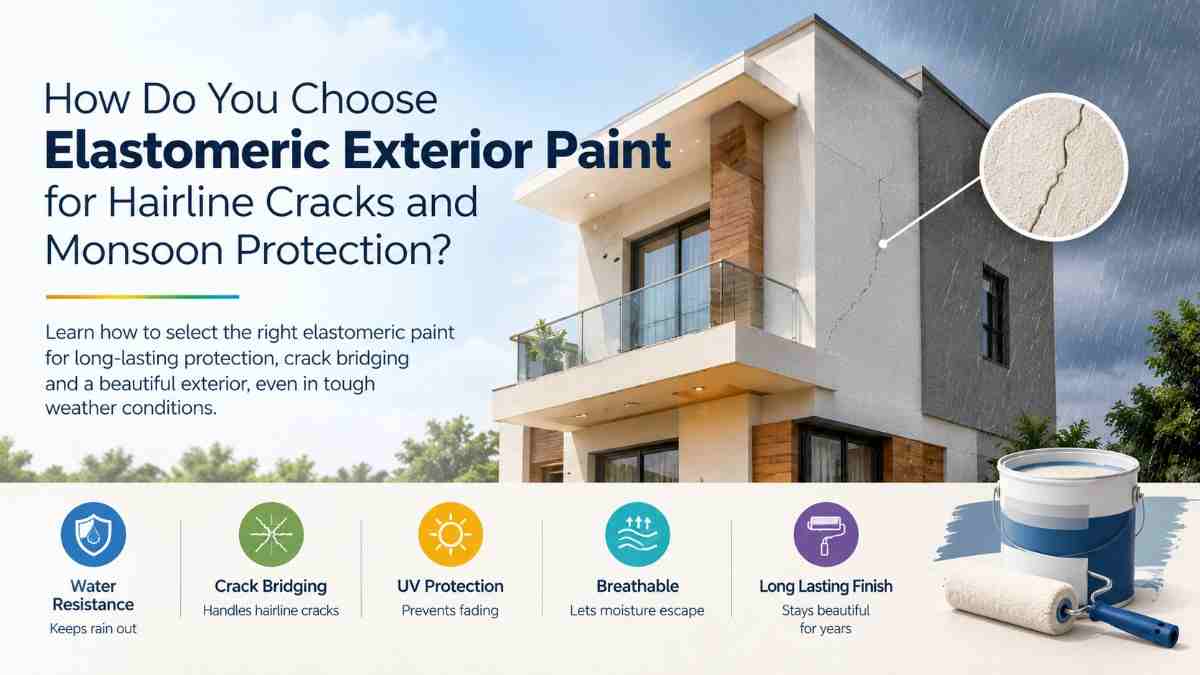
Are hairline cracks, recurring rain exposure, or fading exterior walls affecting your building's appearance? Exterior surfaces in many parts of India face demanding conditions, including intense sunlight, seasonal rainfall, humidity, and temperature changes.
Elastomeric exterior paint is a flexible protective coating designed to accommodate certain limited movements in properly prepared substrates while providing resistance to rainwater penetration. Its suitability depends on the product's tested performance, coating thickness, substrate condition, and application method.
Unlike a conventional decorative finish, an elastomeric coating is selected partly for its ability to maintain a protective film across certain small, nonstructural surface cracks.
However, elastomeric paint is not a substitute for structural repair or a complete waterproofing system.
Godavari Paints offers exterior protective coatings, including Pearl Max Powerflex, Pearl Ultima Protek, and other weather-resistant finishes.
This guide explains how to evaluate elastomeric coatings for homes, high-rise buildings, housing societies, and commercial properties.
Elastomeric exterior paint is a coating formulated with flexible polymer binders that allow the cured film to stretch and recover to a specified degree. It is commonly considered for exterior masonry and concrete surfaces where controlled crack-bridging and weather protection are required.
Its main functions may include:
Reducing rainwater penetration through the coating film.
Accommodating specified limited substrate movement.
Providing decorative exterior finishes.
Protecting suitable masonry and plaster surfaces.
Resisting weathering when properly formulated.
Supporting facade maintenance programs.
Actual performance varies considerably between products.
Elastomeric paint is specifically formulated for greater film flexibility and certain crack-bridging requirements, while ordinary exterior paint may prioritize decorative appearance, weatherability, and general surface protection.
Both categories may offer useful exterior performance.
The selection should consider:
Binder technology.
Tested elongation.
Crack-bridging performance.
Recommended film thickness.
Water resistance.
Water vapor permeability.
Adhesion.
UV exposure.
Application requirements.
A product should not be selected solely because it is described as flexible.
Certain elastomeric coatings can bridge specified small, stable cracks when installed according to their tested system requirements. The maximum movement or crack width must be established from the individual product's technical documentation.
Crack bridging depends on:
Existing crack width.
Expected crack movement.
Substrate stability.
Coating thickness.
Surface preparation.
Product formulation.
Weather conditions.
Application quality.
No. Elastomeric paint cannot repair structural movement, damaged reinforced concrete, or serious cracks in walls and building frames.
Cracks showing significant displacement, continued expansion, or signs of structural distress should be inspected by a qualified professional.
Crack preparation depends on the crack type and the coating system. Some stable microcracks may be accommodated by an appropriately specified coating, while other cracks require compatible fillers, sealants, or repair materials before painting.
Follow a documented crack-treatment specification.
Elastomeric coatings can be suitable for rain-exposed facades when their water-resistance, adhesion, permeability, and application characteristics match the building's exposure conditions.
Monsoon-related risks include:
Wind-driven rain.
Repeated wetting and drying.
Surface contamination.
Water entry through joints.
Exterior plaster cracks.
Poor drainage.
Trapped substrate moisture.
A coating can help protect suitable surfaces, but water entering from roofs, defective windows, or damaged joints must be addressed separately.
Water vapor permeability is important because a coating that restricts water vapor movement too much may contribute to trapped moisture problems on some walls.
Exterior coating selection should balance resistance to liquid water penetration with suitable vapor transmission for the building assembly.
Important considerations include:
Wall construction.
Existing coatings.
Substrate moisture.
Climate.
Indoor humidity.
Water entry pathways.
Coating permeability data.
The appropriate permeability is project-specific.
Exterior walls should be sound, clean, appropriately dry, and repaired before applying an elastomeric coating.
A practical preparation process includes:
Inspect the wall for cracks and loose plaster.
Investigate dampness and water entry.
Remove unstable existing paint.
Clean contaminants and biological growth.
Repair defective plaster.
Treat cracks according to the repair specification.
Confirm the substrate meets application requirements.
Apply the recommended primer, if required.
Apply the specified coating system.
Inspect the completed finish.
Avoid coating over active leaks or deteriorating surfaces.
The correct primer is the one approved for the selected coating and substrate condition. A compatible primer can improve adhesion and help create a consistent base for the finish.
Primer selection depends on:
Concrete or plaster type.
Surface porosity.
Existing coating.
Alkalinity.
Moisture condition.
Topcoat chemistry.
Explore the Godavari Paints Primers Collection and confirm the recommended system with the manufacturer.
Elastomeric paint should be applied using the manufacturer's specified preparation method, number of coats, spread rate, film thickness, and weather restrictions.
Application may involve suitable rollers, brushes, or spray equipment, depending on the product.
Key requirements include:
Correct mixing.
Approved thinning, if permitted.
Specified coverage.
Required wet-film thickness.
Appropriate drying intervals.
Adequate final film build.
Suitable ambient conditions.
Proper curing.
An excessively thin film may not deliver the claimed performance, while excessively thick application can create curing or adhesion problems.
Pearl Max Powerflex is an elastomeric exterior coating listed by Godavari Paints for projects requiring flexible exterior protection.
The company's exterior paint range identifies Powerflex as a product intended for certain hairline-crack and weather-exposure applications.
Review its Exterior Paints Collection for current product information.
Any claim about maximum crack width, percentage elongation, or long-term performance should be checked against the latest product-specific technical data sheet and applicable test method before the product is specified.
High-rise buildings require coating selection based on facade condition, wind-driven rain, access constraints, substrate movement, and long-term maintenance requirements.
Consider:
Exposure at different elevations.
Facade cracks and joints.
Substrate stability.
Surface preparation methods.
Expected maintenance access.
Coating compatibility.
Required appearance.
Applicable performance documentation.
Large projects may benefit from representative trial application areas before full-scale painting.
The cost depends on the coating system, material consumption, surface repairs, labor, access equipment, and required film thickness.
Important cost components include:
Surface inspection.
Crack repairs.
Cleaning and preparation.
Primer.
Finish coating.
Labor.
Access systems.
Quality inspection.
Future maintenance.
Compare complete coating systems rather than only the paint price per liter.
Contractors should verify substrate compatibility, performance specifications, application requirements, coverage, available shades, testing documents, and supply quantities.
A quotation request should include:
Building location.
Exterior surface type.
Total painting area.
Wall condition.
Crack characteristics.
Expected rain exposure.
Existing coating type.
Required finish and color.
Technical performance criteria.
Delivery schedule.
A detailed specification helps prevent mismatches between project expectations and supplied material.
Godavari Paints offers a range of exterior coatings that builders and contractors can evaluate for different weather conditions and facade requirements.
Its exterior product portfolio includes acrylic paints, protective coatings, elastomeric options, and specialty finishes.
Relevant options include Pearl Max Powerflex and Pearl Ultima Protek.
Explore the Exterior Paints Product Range and Paint Consultation Services for project-specific discussions.
Product performance should be evaluated using the appropriate technical documentation.
Common questions concern crack bridging, rain resistance, application, durability, substrate compatibility, and project cost.
Some elastomeric coatings offer resistance to liquid water penetration under specified conditions. They should not automatically be treated as substitutes for all waterproofing systems.
Sometimes, if the existing coating is compatible, firmly bonded, clean, and prepared correctly. An adhesion assessment may be necessary.
No. Its crack-bridging capability is limited and product-specific. Active structural cracks require appropriate repair.
Yes, when the coating is approved for the concrete substrate and relevant exposure conditions.
It may be suitable for selected coastal applications, but chloride exposure, moisture, substrate condition, and protective requirements must be evaluated.
Service life depends on product formulation, substrate, climate, application quality, film thickness, and maintenance. Confirm product-specific warranty and performance information.
Primer requirements depend on the product and substrate. Follow the approved system.
Application during rain or unsuitable moisture conditions should generally be avoided unless explicitly permitted by the product instructions.
You can request exterior coating recommendations by sharing your building location, substrate type, wall condition, painting area, desired finish, and weather-exposure requirements.
For residential buildings, commercial properties, high-rise facades, and housing societies, selecting the complete coating system is more important than choosing a product based only on appearance.
Explore Godavari Paints Exterior Coatings or contact Godavari Paints for product information and project quotations.
Technical Note: Crack bridging, elongation, weather resistance, and water permeability must be assessed using product-specific test data and application requirements. Structural cracks and active water-entry defects require separate corrective measures.

When we think about painting a property, it's easy to focus purely on aesthetics—the perfect shade o...
read more
When stepping into a home, an office, or a healthcare facility, the walls do more than define the st...
read more
When planning a painting project, it is easy to get caught up in choosing the perfect topcoat color...
read more
Every architectural masterpiece demands a flawless canvas, and extraordinary walls are no exception....
read more
Are you responsible for maintaining a reinforced concrete building, commercial structure, bridge, or...
read more
Are you looking for a decorative wall finish that adds depth, character, and visual interest to a ho...
read more
Have you noticed paint peeling from your walls, bubbles forming under the painted surface, or fine c...
read more