
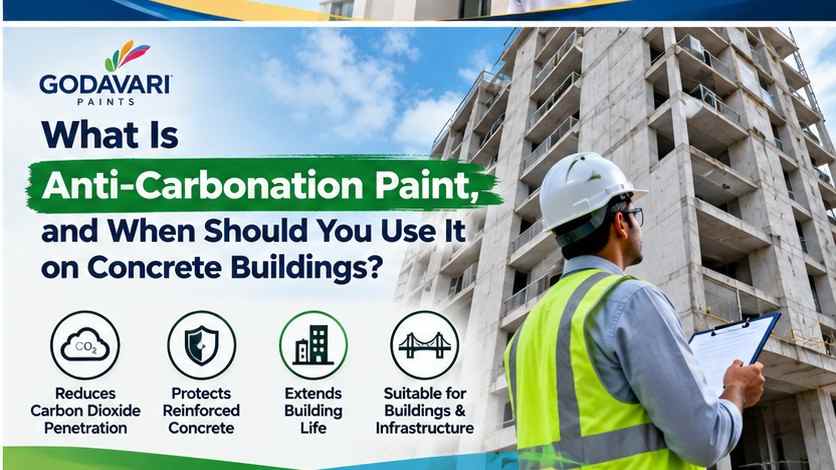
Are you responsible for maintaining a reinforced concrete building, commercial structure, bridge, or high-rise facade? Concrete may appear strong and durable, but long-term exposure to environmental conditions can gradually affect its protective properties, particularly around embedded steel reinforcement.
Anti-carbonation paint is a protective coating designed to reduce carbon dioxide penetration into concrete, helping slow the carbonation process that can contribute to reinforcement corrosion. The coating forms a protective barrier when applied to a suitable, properly prepared surface at the specified thickness.
Concrete carbonation is a gradual chemical process. Its effect depends on concrete quality, moisture conditions, environmental exposure, and the existing depth of carbonation.
For architects, civil engineers, contractors, and building owners, selecting the right protective coating can form part of a broader concrete maintenance strategy.
Godavari Paints offers exterior protective coatings, including Pearl Longlife Anti Carbonation Paint, for suitable concrete and masonry applications.
This guide explains concrete carbonation, how anti-carbonation coatings work, and what to check before specifying a protective coating for a building or infrastructure project.
Concrete carbonation is a chemical process in which carbon dioxide from the atmosphere reacts with alkaline compounds in concrete, gradually reducing its alkalinity.
Fresh, sound concrete typically has a highly alkaline pore solution that helps maintain a passive protective layer around embedded steel reinforcement.
As carbonation advances, the alkalinity of the affected concrete decreases.
If the carbonation front reaches the reinforcing steel, the protective environment around the reinforcement may be reduced.
Corrosion can then become possible when sufficient moisture and oxygen are present.
Concrete carbonation becomes a concern when the reduction in alkalinity reaches embedded reinforcement and creates conditions that can support steel corrosion.
Corroding reinforcement may expand as rust products form, contributing to:
Cracking along reinforcement locations.
Delamination of concrete cover.
Spalling.
Staining.
Localized deterioration.
Reduced durability.
Increased repair requirements.
Carbonation alone does not automatically mean that reinforcing steel is corroding.
The actual condition depends on carbonation depth, concrete cover, moisture, oxygen availability, and other environmental factors.
Anti-carbonation paint protects suitable concrete surfaces by creating a coating film that reduces the rate at which carbon dioxide passes into the substrate.
A well-designed protective system may also provide resistance to rainwater penetration and weather exposure.
Important performance characteristics include:
Resistance to carbon dioxide diffusion.
Adhesion to prepared concrete.
Appropriate water vapor permeability.
Resistance to liquid water penetration.
UV and weathering resistance.
Crack-bridging performance where specified.
Coating durability.
Compatibility with the substrate.
These properties must be evaluated using the actual product's technical data and relevant test results.
Anti-carbonation coatings are specifically selected for documented carbon dioxide barrier performance, while conventional exterior paints may primarily focus on decorative appearance and general weather protection.
Both types of coating can have useful protective properties.
However, an exterior paint should not be described as a certified anti-carbonation system unless its performance has been demonstrated through appropriate testing.
When comparing options, check:
Carbon dioxide diffusion resistance.
Water vapor permeability.
Liquid water absorption.
Adhesion.
Crack-bridging requirements.
Application film thickness.
Long-term weathering performance.
Anti-carbonation coatings can be considered for exposed reinforced concrete structures where controlling additional carbon dioxide penetration is part of the approved durability strategy.
Potential applications include:
High-rise residential buildings.
Commercial buildings.
Parking structures.
Bridges and flyovers.
Exposed reinforced concrete walls.
Industrial facilities.
Selected infrastructure structures.
Concrete facades.
Public buildings.
Not every concrete surface requires an anti-carbonation coating.
The decision should be based on exposure, existing condition, design requirements, and maintenance objectives.
A concrete building may need anti-carbonation protection when inspection identifies relevant exposure risks, progressing carbonation, or a durability requirement for the structure.
Before specifying the coating, assess:
Age of the structure.
Concrete quality.
Environmental exposure.
Existing cracks.
Moisture conditions.
Concrete cover depth.
Carbonation depth.
Reinforcement condition.
Existing coating performance.
Maintenance history.
A qualified professional should interpret the results for significant structural assets.
Carbonation depth can be assessed by exposing a fresh concrete surface and applying an appropriate chemical indicator, commonly phenolphthalein solution, under a recognized test procedure.
The indicator response helps distinguish regions with different alkalinity characteristics.
The measurement can provide useful information about carbonation progression.
However, the test has limitations and does not independently establish reinforcement corrosion or remaining structural capacity.
Sampling methods and interpretation should be carried out by qualified personnel.
No. Anti-carbonation paint cannot restore damaged reinforcement, replace lost concrete, or reverse carbonation that has already occurred.
If a structure has deteriorated, repairs may be needed before protective coating application.
Possible work includes:
Concrete condition assessment.
Removal of unsound concrete.
Reinforcement inspection.
Corrosion treatment where specified.
Concrete repair.
Crack treatment.
Surface preparation.
Application of an approved protective system.
The repair process should follow the recommendations of an appropriate civil or structural engineer.
Concrete should be sound, clean, appropriately dry, repaired where necessary, and compatible with the selected coating system before application.
A typical preparation process includes:
Inspect the concrete surface.
Identify cracks and delamination.
Investigate moisture problems.
Remove loose or incompatible existing coatings.
Clean contaminants.
Repair damaged concrete.
Treat cracks and joints appropriately.
Verify surface strength and condition.
Apply the specified primer where required.
Apply the protective coating according to the approved specification.
Surface preparation is essential because even a technically suitable coating can fail when applied to an unstable substrate.
Primer requirements depend on the concrete condition, surface porosity, and selected anti-carbonation coating system.
A compatible primer may improve adhesion and regulate absorption.
However, not every coating system uses the same primer.
Review the Godavari Paints Primers Collection and confirm the appropriate system before purchasing.
The required coating thickness depends on the product's tested protective performance and the design specification. There is no universal film thickness suitable for every anti-carbonation coating.
Thickness may be expressed as:
Wet-film thickness.
Dry-film thickness.
Nominal coating thickness.
Total system thickness.
The required dry-film thickness should correspond to the product's documented carbon dioxide barrier performance.
Contractors should use suitable inspection methods to verify that the finished coating meets the approved specification.
Applying an arbitrary thicker layer does not automatically ensure better performance.
Water vapor permeability is important because concrete protective coatings may need to restrict certain external substances while allowing an appropriate level of moisture vapor movement.
A coating that is unsuitable for the substrate's moisture condition can contribute to:
Blistering.
Loss of adhesion.
Trapped moisture.
Surface deterioration.
Premature coating failure.
The correct balance depends on the concrete condition, environment, and complete building assembly.
Anti-carbonation paint may help reduce one pathway that contributes to reinforcement corrosion by slowing additional carbon dioxide penetration. It cannot prevent every corrosion mechanism.
Reinforcement corrosion can also be influenced by:
Chloride contamination.
Existing carbonation.
Water penetration.
Cracks.
Inadequate concrete cover.
Poor-quality repairs.
Environmental exposure.
A protective coating should be part of a coordinated concrete durability strategy.
Anti-carbonation paint may be suitable for selected coastal concrete structures when the coating system also meets the project's moisture, chloride-exposure, weathering, and adhesion requirements.
Coastal environments introduce additional durability concerns, especially chloride-induced reinforcement corrosion.
Carbon dioxide barrier performance alone does not establish resistance to chloride penetration.
Engineers should review the full protective coating specification.
Pearl Longlife Anti Carbonation Paint is an exterior protective coating listed by Godavari Paints for concrete surfaces requiring carbonation-related protection.
The product appears in the company's exterior coating portfolio alongside other protective and decorative finishes.
Potential project applications may include exposed reinforced concrete and suitable building facades.
Buyers should obtain the current technical data sheet to confirm:
Approved substrates.
Carbon dioxide diffusion performance.
Water vapor permeability.
Water absorption.
Application thickness.
Primer compatibility.
Surface preparation.
Relevant testing.
Maintenance requirements.
Explore the Pearl Longlife Anti Carbonation Paint Product Page for available information.
Engineers should consider relevant concrete protection standards and project specifications that address coating performance, durability, and application requirements.
For projects using European standards, EN 1504-2 covers surface protection systems for concrete.
Depending on the selected protection method, relevant characteristics can include:
Carbon dioxide permeability.
Water vapor permeability.
Capillary water absorption.
Adhesion.
Crack bridging.
Weathering.
Other specified performance properties.
The standard's applicable requirements depend on the intended use and protection principle.
For Indian projects, confirm relevant local standards, contractual specifications, and engineering requirements.
Completed anti-carbonation coating systems should be inspected for surface condition, coverage, thickness, adhesion-related requirements, and compliance with the approved application specification.
Important checks include:
Consistent surface coverage.
Required film thickness.
Visible defects.
Pinholes.
Blistering.
Cracking.
Adhesion testing where specified.
Coating continuity.
Proper treatment around joints.
Inspection documentation.
Not every performance characteristic can be verified through visual inspection alone.
Use the test methods required by the project's quality plan.
The service life of an anti-carbonation coating depends on product formulation, environmental exposure, concrete condition, application quality, and maintenance.
Important factors include:
Sunlight exposure.
Rain and humidity.
Substrate movement.
Surface contamination.
Existing concrete defects.
Coating thickness.
Maintenance frequency.
A universal service-life guarantee should not be assumed.
Ask the supplier for product-specific performance information and applicable warranty terms.
Project costs depend on the coating specification, concrete condition, surface repairs, application area, access requirements, and inspection procedures.
Major cost factors include:
Initial concrete assessment.
Surface cleaning.
Concrete repairs.
Crack treatment.
Primer.
Protective coating.
Skilled application.
Access equipment.
Quality testing.
Maintenance planning.
On large infrastructure projects, the coating material price represents only one part of the total cost.
An anti-carbonation coating RFQ should define the concrete substrate, environmental exposure, performance requirements, application area, surface condition, and documentation needed for the project.
Provide:
Project type: Bridge, building, parking structure, or other concrete asset.
Location: City and project environment.
Substrate: Concrete grade and surface condition, where known.
Exposure: Rain, pollution, coastal conditions, or other relevant factors.
Area: Approximate square footage or square meters.
Condition: Existing cracks, repairs, or coatings.
Performance: Required carbon dioxide resistance and other properties.
System: Primer and finish requirements.
Inspection: Required test methods.
Documentation: Product data and certificates.
Schedule: Expected application timeline.
Delivery: Site location and supply requirements.
A detailed RFQ helps suppliers identify an appropriate coating system for technical evaluation.
Godavari Paints supplies exterior protective coatings, including products intended for concrete durability and weather-exposure applications.
Its portfolio includes:
Pearl Longlife Anti Carbonation Paint.
Pearl Max Powerflex.
Pearl Ultima Protek.
Other exterior acrylic coatings.
Primers and surface preparation materials.
For significant concrete protection projects, contractors should obtain the latest technical data and confirm performance requirements before specifying the product.
Explore the Exterior Paints Collection and Paint Consultation Services for project information.
Common questions concern carbonation protection, concrete corrosion, coating thickness, testing, and suitability for particular structures.
Its primary purpose is to reduce carbon dioxide penetration into suitable concrete surfaces and help slow further carbonation.
It may slow additional carbonation when correctly specified and applied, but it does not chemically reverse carbonation already present in concrete.
Not necessarily. Crack-bridging performance depends on the product, and structural cracking requires separate investigation and repair.
No. Anti-carbonation coatings are selected for specific carbon dioxide barrier performance. Liquid water resistance may also be relevant, but it is a separate technical property.
Yes, potentially, provided the concrete is assessed, repaired where necessary, and properly prepared for the selected coating.
Certain anti-carbonation systems can be used on bridge concrete when their performance meets the engineering specification.
Primer requirements depend on the coating and substrate. Follow the approved system specification.
Carbon dioxide barrier performance does not by itself establish chloride protection. Additional performance requirements may apply.
Carbonation depth can be evaluated using recognized sampling and indicator methods interpreted by appropriately qualified personnel.
No. Deteriorated concrete and damaged reinforcement must be evaluated and repaired appropriately before protective coating application.
You can request anti-carbonation coating information from Godavari Paints by providing details of your concrete structure, existing condition, surface area, environmental exposure, and technical performance requirements.
For commercial buildings, residential towers, bridges, parking structures, and infrastructure projects, the coating must be selected as part of the complete concrete protection strategy.
Explore Pearl Longlife Anti Carbonation Paint, review the Exterior Coatings Collection, or contact Godavari Paints for project-specific enquiries.
Technical Note: Anti-carbonation coatings are preventive surface protection measures, not structural repairs. Existing reinforcement corrosion, concrete deterioration, chloride contamination, and structural defects require appropriate professional assessment and remediation.

When we think about painting a property, it's easy to focus purely on aesthetics—the perfect shade o...
read more
When stepping into a home, an office, or a healthcare facility, the walls do more than define the st...
read more
When planning a painting project, it is easy to get caught up in choosing the perfect topcoat color...
read more
Every architectural masterpiece demands a flawless canvas, and extraordinary walls are no exception....
read more
Are you looking for a decorative wall finish that adds depth, character, and visual interest to a ho...
read more
Are hairline cracks, recurring rain exposure, or fading exterior walls affecting your building's app...
read more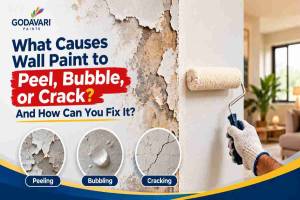
Have you noticed paint peeling from your walls, bubbles forming under the painted surface, or fine c...
read more