
Are you looking for a decorative wall finish that adds depth, character, and visual interest to a home, office, hotel, or commercial building? Textured wall finishes offer an alternative to standard smooth paint by creating visible or tactile patterns on the surface.
The right textured wall finish depends on the desired appearance, interior or exterior exposure, substrate condition, application method, maintenance needs, and project budget. Stone-inspired textures, roller patterns, comb finishes, and sand-textured coatings create different decorative effects.
However, appearance should not be the only consideration. The selected coating must also suit the substrate and expected environmental conditions.
Godavari Paints offers decorative textured coatings through its Inspira range and other wall-finishing products.
This guide explains popular textured wall finish types, where they can be used, and what architects, homeowners, and contractors should check before ordering.
A textured wall finish is a decorative coating or surface treatment designed to create visible or tactile patterns rather than a completely smooth painted surface.
Depending on the product, texture may be created using:
Mineral aggregates.
Graded sand.
Special coating compounds.
Decorative flakes.
Texturing rollers.
Combs and hand tools.
Spray application.
Specialized finishing techniques.
Different techniques create different visual and maintenance characteristics.
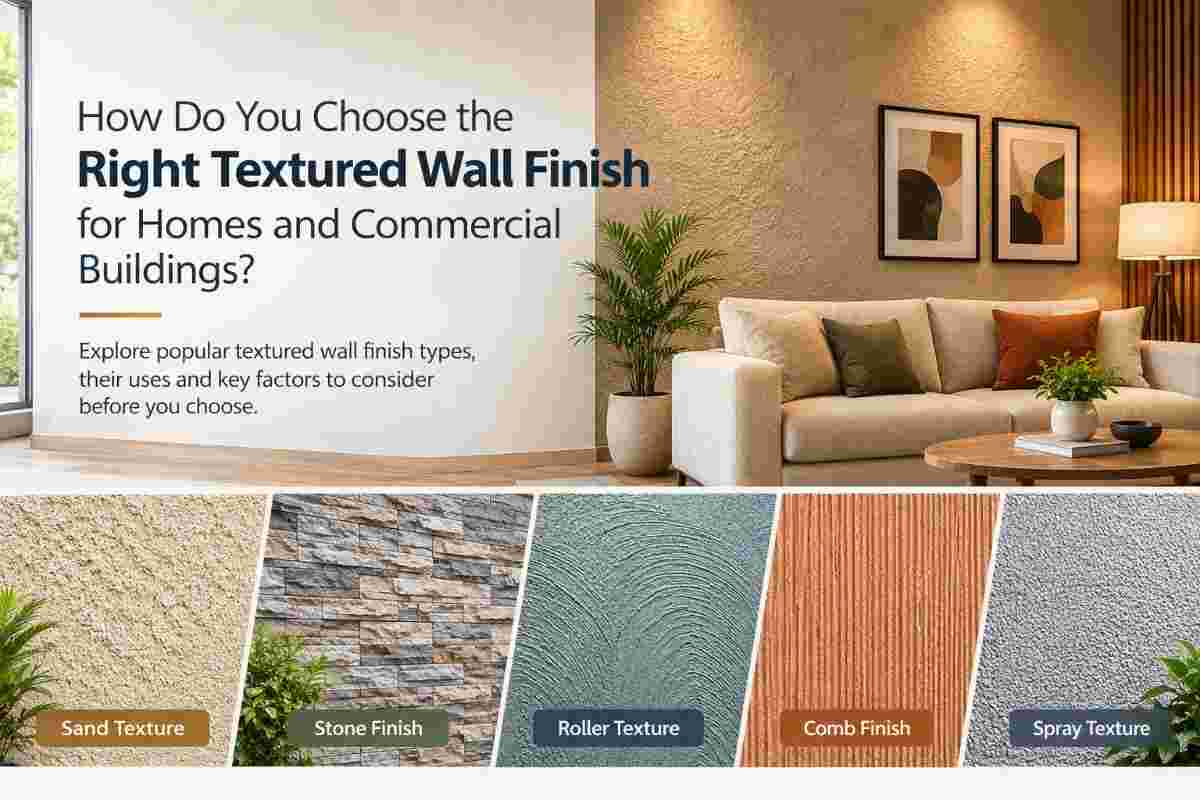
Common textured wall finishes include sand textures, stone-inspired finishes, roller textures, comb patterns, and sprayed decorative textures.
Each type creates a different surface appearance and requires its own application technique.
A sand-textured finish uses suitable granular materials to create a uniform or patterned surface with visible grain.
It may be considered for:
Exterior facades.
Boundary walls.
Feature areas.
Commercial buildings.
Decorative masonry surfaces.
Coarse textures may help visually reduce the appearance of certain minor surface irregularities, but they do not repair defective plaster.
A stone-finish wall texture is a decorative coating designed to resemble the visual appearance of natural stone or mineral surfaces.
It can be considered for:
Building entrances.
Facade highlights.
Feature walls.
Lobby areas.
Commercial elevations.
Stone-look coatings are not necessarily equivalent to natural stone in structural behavior, impact resistance, or maintenance requirements.
A roller texture finish uses a coating and suitable patterned application tools to create decorative impressions on the wall.
Possible effects include:
Repeating patterns.
Raised decorative textures.
Subtle linen-like finishes.
Organic irregular patterns.
Accent wall designs.
The final appearance depends on applicator skill, material consistency, and the technique used.
A comb-finish wall texture creates linear, curved, or geometric grooves using a suitable comb-like application tool while the material is workable.
It is often selected for feature walls and areas where a distinctive handcrafted design is desired.
A spray-applied texture uses suitable equipment to distribute a decorative coating in a controlled pattern across a prepared surface.
Spray application can be useful for larger areas, but it requires the correct equipment, masking, application technique, and material specifications.
Living rooms often benefit from textures that complement the furniture, lighting, wall size, and overall interior design.
Popular approaches include:
Subtle roller texture behind a sofa.
Stone-inspired accent walls.
Linear comb patterns.
Fine decorative textures.
Neutral-colored feature walls.
Consider how artificial and natural light will interact with the surface.
Strong textures can create pronounced shadows, while fine textures may provide a more restrained visual effect.
Commercial spaces should use textures that match their design requirements, expected traffic, cleaning needs, and maintenance budget.
Possible applications include:
Reception areas.
Meeting rooms.
Office feature walls.
Retail showrooms.
Hotel lobbies.
Restaurant interiors.
Commercial entrance areas.
High-contact surfaces may require finishes that are easier to maintain or repair.
Select the product using its documented suitability rather than assuming every decorative texture offers equal durability.
Yes. Certain textured coatings are suitable for exterior surfaces when their formulation, substrate compatibility, weather resistance, and application system support outdoor use.
Exterior requirements may include:
UV exposure.
Rain resistance.
Suitable water vapor behavior.
Algae resistance.
Substrate adhesion.
Thermal movement.
Cleaning requirements.
Browse the Textured Paints Collection for available options.
Walls should be sound, clean, appropriately dry, and properly prepared before textured coatings are applied.
Recommended preparation steps include:
Inspect the substrate.
Identify cracks and damaged plaster.
Correct moisture problems.
Remove loose old coatings.
Clean dust, grease, and contaminants.
Repair defects with suitable materials.
Check surface uniformity.
Apply the specified primer.
Prepare a sample texture panel.
Begin full application after approval.
A texture coating should not be used to conceal serious substrate defects.
Primer may be necessary to provide a compatible base, control substrate absorption, and support adhesion of the specified decorative coating.
The primer should match:
Substrate type.
Surface condition.
Texture coating chemistry.
Interior or exterior exposure.
Manufacturer requirements.
Review the Primers Collection when planning the complete finishing system.
Regular emulsion paint typically produces a relatively smooth decorative film, while textured coatings are designed to create a pronounced surface pattern or relief.
Textured coatings may require different:
Surface preparation.
Application tools.
Material consumption.
Skilled labor.
Film thickness.
Drying conditions.
Maintenance methods.
A regular emulsion can still be used in coordinated decorative schemes, depending on the system.
Godavari Paints offers several Inspira textured finishes with different decorative appearances and application methods.
The website lists:
Inspira Duraplast Texture: A textured coating intended to create a stone-inspired appearance.
Inspira Elite Stone Finish: A decorative stone-look finish.
Inspira Décor Roller Texture: A roller-applied decorative finish.
Inspira Comb Finish: A finish designed for comb-created patterns.
Browse Godavari Textured Paints to review product options and select an appropriate finish.
Choose a texture color based on lighting, room size, nearby materials, desired contrast, and the maintenance needs of the surface.
For example:
Light neutral shades can support bright interior schemes.
Warm earthy tones can complement stone and wood.
Dark shades may create stronger visual contrast.
Two-tone combinations can emphasize surface patterns.
Always evaluate an approved sample under the actual site lighting.
Digital colors may not accurately represent the finished textured surface.
Textured wall finishes should be maintained using cleaning methods appropriate to their surface structure and coating chemistry.
Recommended practices include:
Remove dust using suitable soft tools.
Clean only with approved products.
Avoid aggressive scrubbing.
Address moisture problems promptly.
Inspect exterior areas periodically.
Repair damaged sections using compatible materials.
Deep textures can collect more dust than smooth walls.
A maintenance plan should reflect the location and type of finish.
Localized repairs may be possible, but matching the original texture, pattern, color, and finish can be difficult.
Repair quality depends on:
Original application method.
Age of the coating.
Texture pattern.
Available material.
Surface damage.
Applicator skill.
For visually prominent areas, a larger controlled repair section may sometimes produce a more consistent result.
Textured wall finish costs depend on the material, design complexity, substrate condition, labor, coverage, and application technique.
Cost factors include:
Coating type.
Aggregate or texture composition.
Surface repairs.
Primer.
Sample panels.
Skilled application.
Pattern complexity.
Total area.
Access requirements.
Maintenance expectations.
Compare complete installed costs rather than only material cost per liter or kilogram.
Godavari Paints offers multiple texture products that architects and designers can evaluate for residential, commercial, and selected exterior applications.
Its textured products include stone-inspired, roller-patterned, and comb-finish options.
For project selection, request:
Product technical information.
Sample finishes.
Color options.
Substrate requirements.
Coverage information.
Application instructions.
Maintenance guidance.
Explore its Textured Paint Range and Texture Application Services for project discussions.
Common questions concern texture selection, installation, maintenance, exterior suitability, and repair.
The best choice depends on the room's lighting, decorative style, wall dimensions, and maintenance preferences. Roller and comb textures may be suitable options.
Yes, appropriate interior textured finishes can be used in bedrooms, particularly for accent walls.
Some textures can visually reduce the appearance of minor irregularities, but damaged or unstable plaster must be repaired first.
Sometimes. Repainting depends on the existing coating condition, surface relief, and compatibility of the new paint system.
Not automatically. Water resistance depends on the selected product and complete coating system.
Usually, stone-look decorative coatings imitate certain visual characteristics of natural stone without necessarily using solid stone panels.
Many decorative textures benefit from trained applicators to achieve consistent pattern and finish quality.
Some textures allow different colors, patterns, or application effects. Feasibility depends on the product and application technique.
You can request textured wall finish recommendations by sharing the project type, wall condition, total area, interior or exterior location, and preferred decorative appearance.
For homes, offices, hotels, showrooms, and commercial buildings, request sample panels before selecting the final finish.
Explore the Godavari Paints Textured Finishes or contact Godavari Paints for available products and project quotations.

When we think about painting a property, it's easy to focus purely on aesthetics—the perfect shade o...
read more
When stepping into a home, an office, or a healthcare facility, the walls do more than define the st...
read more
When planning a painting project, it is easy to get caught up in choosing the perfect topcoat color...
read more
Every architectural masterpiece demands a flawless canvas, and extraordinary walls are no exception....
read more
Are you responsible for maintaining a reinforced concrete building, commercial structure, bridge, or...
read more
Are hairline cracks, recurring rain exposure, or fading exterior walls affecting your building's app...
read more
Have you noticed paint peeling from your walls, bubbles forming under the painted surface, or fine c...
read more